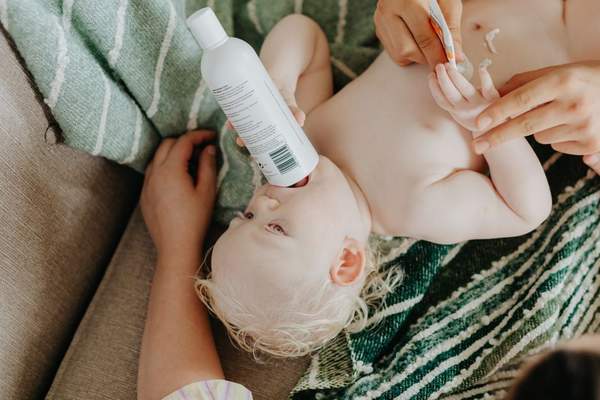

Choosing a baby lotion for sensitive skin is less about finding the most “natural” label and more about finding a formula your baby’s skin tolerates. Fragrance, texture, preservatives, and plant extracts can affect eczema-prone skin differently. For babies with persistent dryness or eczema, UK guidance generally favours regular emollient use to support the skin barrier, with medical treatment added when a flare needs it.
What matters most in a lotion for sensitive baby skin?
A useful starting point is a short ingredient list, no added fragrance, and a texture you can apply often enough to keep the skin comfortable. Lotions are light and easy to spread, but very dry eczema baby skin may need a richer cream, balm, or ointment because these leave a stronger protective layer.
“Natural” and “chemical-free” are not medical safety standards. Natural ingredients can still trigger irritation or allergy, while familiar synthetic ingredients such as glycerin, petrolatum, or ceramides can be useful in sensitive-skin products. For parents interested in natural baby skincare, the better question is whether a product is fragrance-free, age-appropriate, well tolerated, and suitable for the level of dryness.
Best gentle options to compare
Childs Farm OatDerma Body Moisturiser
Childs Farm OatDerma is one of the strongest matches for parents specifically looking for an oatmeal baby lotion with a high natural-origin content. The fragrance-free body moisturiser contains oat kernel flour, oat oil, glycerin, shea butter, and cocoa butter. The manufacturer states that it is suitable from newborn age and for sensitive skin that may be prone to eczema.
Its main advantage is the balance between a familiar moisturising texture and a formula built around oats without added fragrance. It may suit everyday whole-body use when skin is dry or itchy but does not need the heavier feel of an ointment. As with any product, stop if irritation develops.
Aveeno Baby Dermexa Emollient Cream
Aveeno Baby Dermexa is aimed at very dry, itchy baby skin and combines oat ingredients with glycerin, petrolatum, dimethicone, panthenol, and a ceramide. That makes it less “plant-only” than some shoppers expect from natural baby skincare, but the formula illustrates why ingredient function matters more than a natural marketing claim.
This is useful when the priority is barrier support rather than the lightest lotion. Its ingredient list does not include parfum, and the richer cream format may suit rough, dry patches better. Check the current pack because formulas can change.
Childs Farm Baby All Over Balm Fragrance Free
This is not technically a lotion, but it earns a place in a sensitive-skin comparison because some babies need a richer product on local dry areas. The fragrance-free balm contains glycerin, shea butter, sunflower-derived ingredients, aloe, and cucumber, and is marketed for newborns with dry, sensitive skin.
A balm can help when a lightweight moisturiser disappears quickly from dry cheeks, elbows, or small patches. It is less convenient for whole-body use, so a lotion or cream may be easier for routine moisturising and a balm for targeted areas.
E45 Cream
E45 is the deliberate non-“natural” comparison. It is fragrance-free and uses paraffin-based emollients plus lanolin to reduce moisture loss. The manufacturer says it can be used for babies over one month and for dry skin conditions including eczema. For a family whose baby tolerates it, a simple conventional emollient may work better than a product chosen mainly for botanical ingredients.
This option is particularly useful for showing why “natural” should not be the deciding factor. Sensitive skin care is about tolerability and regular moisturising. However, lanolin can be unsuitable for some people, so a different emollient may be needed if irritation occurs.
Fragrance-free is usually more useful than “natural”
Fragrance is a common reason parents simplify a routine when a baby has reactive skin. A fragrance-free baby lotion avoids perfume added for scent, but that does not guarantee every ingredient will suit every child. Essential oils can also contain naturally occurring fragrance components, so “with essential oils” is not automatically a gentler choice for eczema-prone skin.
If your baby reacts often, introduce one new moisturiser at a time. That makes it easier to notice whether redness, stinging, or itching changes after application. Our guide to baby bath products for sensitive skin is a natural next step when cleansers may also be contributing to dryness.
How to use emollients on eczema-prone skin
Moisturisers work best when they are used consistently, not only when the skin looks very dry. Smooth the product gently over the skin rather than rubbing hard. Many families find it convenient to moisturise after bathing and again whenever the skin feels dry or tight.
Ordinary soaps and fragranced washes can worsen dryness, so a gentle cleanser or an emollient used as a soap substitute may be appropriate. A baby eczema care routine should stay simple enough to repeat every day. Our baby skincare routine for dry skin and guide to fragrance-free baby products can help organise the rest of the routine without adding unnecessary products.
A practical way to choose between products
Imagine a three-month-old with dry cheeks and rough arm patches. Choose one age-appropriate fragrance-free emollient and use it consistently while keeping the rest of the routine unchanged. If the cheeks remain much drier, add a richer balm or cream only to those areas rather than replacing the whole routine.
If the skin becomes increasingly red, weepy, crusted, painful, or intensely itchy, changing lotions repeatedly is not the right next step. Eczema flares or infection can require assessment and treatment from a pharmacist, health visitor, GP, or other qualified clinician.
Frequently asked questions
Is oatmeal good for sensitive baby skin?
Oat-based moisturisers are commonly used in products for dry and sensitive skin, and many babies tolerate them well. They are not automatically best for every child, so stop using an oatmeal product if it appears to worsen irritation.
Should babies with eczema use lotion or cream?
It depends on how dry the skin is and what the baby tolerates. Lotions are lighter, creams are richer, and ointments provide a stronger barrier. Very dry skin often benefits from a richer emollient, while a lighter product may be easier for frequent daytime use.
Does fragrance-free mean hypoallergenic?
No. Fragrance-free removes one potential source of irritation, but a baby can still react to another ingredient. “Hypoallergenic” also does not guarantee that a reaction is impossible.
Can moisturiser cure baby eczema?
No. Regular emollients help manage dryness and support the skin barrier, but eczema can still flare and may need additional treatment. Seek medical advice when symptoms are persistent, severe, infected-looking, or disrupting sleep.
Choose the formula your baby will tolerate consistently
The best baby lotion for sensitive skin is not necessarily the one with the highest percentage of natural-origin ingredients. For many families, fragrance-free formulas, simple routines, and regular emollient use matter more. Oat-based options such as Childs Farm OatDerma and Aveeno Baby Dermexa can be useful comparisons, while richer balms or conventional emollient creams may suit drier skin better. Start with one age-appropriate product, watch how the skin responds, and treat eczema as a skin condition rather than a shopping problem when symptoms need professional care.